
Word Witch Correspondence: Perdita Finn
Listening to the dead


Word Witch is a Substack Bestseller and a community of Word Witches, like you! This reader-supported publication is dedicated to your creativity, the cycles and seasons, creating prompts, and sharing interviews, conversations, and poems about word witchery. For the full experience and to support this work for others, consider upgrading your subscription to a paid plan. For $7/month, you’ll receive a monthly writing workshop, channeled messages, and astrological prompts. I publish most of the writing for free to keep it accessible to as many people as I can. Your support makes this possible and means so much to me.
Clicking “like” on this post, sharing, and leaving a comment mean a lot. Thank you for engaging and being here! To your Word Witchery, Kate
The Word Witch Correspondence Series is a pair of letters between a Word Witch friend and me. These letters are meant to muse over the creative process, discuss what it means to build a writing life, and weave interviews and rituals into the text. The word correspondence comes from Medieval Latin, meaning to harmonize or reciprocate. This harmonization and act of reciprocity show that we never write alone. We’re a part of a vast web of Word Witches who love the magic of writing.
Readers, for context: I first met Perdita Finn after her beautiful book Take Back the Magic was published. I was lucky enough to receive a copy through Running Press, and thank the Gods I did, because this book profoundly changed my life. Perdita joined Kristin Lisenby and me on the Magick & Alchemy podcast, and we discussed the magic of working with the beloved dead, writing, creativity, past lives, rituals, and more. Since that first conversation, I have marveled at Perdita (and her family’s) work in the world. She recently published Mothers of Magic and joined us again on Magick & Alchemy to talk about mothering, matriarchy, word witchery, and the power of listening through the veil. It is an honor to be a woman in the world of books connected to Perdita, and I know you will feel the same as you explore her work (if you don’t know and love her already!).
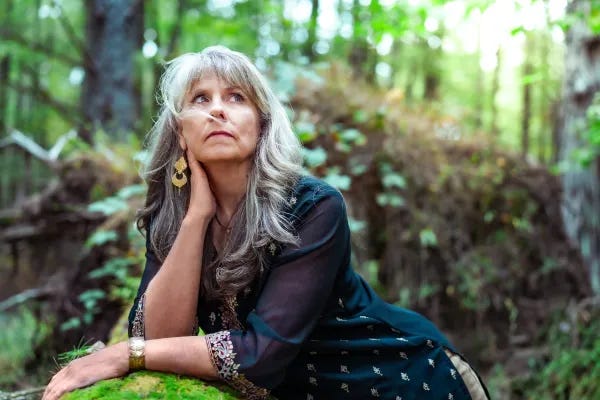
Perdita Finn, Professional Bio: Perdita Finn is the co-founder, with her husband Clark Strand, of the feral fellowship The Way of the Rose, which inspired their book The Way of the Rose: The Radical Path of the Divine Feminine Hidden in the Rosary. They are currently at work on their next book together Circles Not Lines: Spiritual Community Beyond Patriarchy. To find out more about her devotion to “ecology not theology” visit wayoftherose.org
In addition to extensive study with Zen masters, priests, spirit workers, and healers, she apprenticed with the psychic Susan Saxman, with whom she wrote The Reluctant Psychic. Perdita Finn now teaches popular workshops on Getting to Know the Dead. Participants are empowered to activate the miracles in their own lives with the help of their ancestors and recover their own intuitive magic. Her book Take Back the Magic: Conversations with the Unseen World is an intimate journey through her recovery of these lost ways. She speaks widely on how to collaborate with those on the other side, on the urgent necessity of a new romantic animism, and on the sobriety that emerges when we claim the long story of our souls. Her newest book is Mothers of Magic: Summoning the Wisdom of Our Ancestors, is an intervention for our time and a map back to the maternal wisdom that has always been ours – a path toward true connection and the deepest sources of love.
She lives with her family in the moss-filled shadows of the Catskill Mountains.
Dear Perdita,
I am so grateful to be writing to you today! It is summer here in the northern hemisphere, and I’m feeling the buzz of the wild world around me. I’m so excited to share our podcast episode about Mothers of Magic, and I wonder if you could speak a little bit more about the Word Witch practice of writing this book. What were your rituals? What inspired you? What guided you on the process?
Would you call yourself a Word Witch? What does this name mean to you, if so? I’ve spoken with you extensively and have been so inspired by the work you do with the dead. Can you share a little bit more about what this means to you today? Who are the dead? How can we work with them? Do they have any messages they’d like to share through you today? What advice do they have about the writing of the collective?
Do you have any creative rituals of summer? What’s on your altar these days? If you were to craft an altar dedicated to the writers who came before you, our creative ancestors, who are five authors or writers you would dedicate this altar to?
I’m so curious about what you’re reading right now (I just picked up a copy of Hymn to Dionysus by Natasha Pulley that you recommended, and I can’t wait). Do you remember a book you loved when you were a teenager?
As someone who has spent a career in publishing, what advice do you have for writers who want to begin a publishing path? Any final words of wisdom?
Thank you so much for sharing your magic with us!
Lots of love,
Kate
Dear Kate,
I write about the dead—with the dead at my back, with the dead whispering in my ear. When I speak of the dead, I am talking not just about my biological forbears—the grandmothers and great uncles, the names I’ve collected from this genealogy or that ancestry website—but all of the dead I have known and all of the dead I do not remember but who remember me. On the altar behind my desk are photos of teachers, friends, the girls who died at my daughter’s college her sophomore year, the son of a woman I met only once but who came to me in a dream, a gravestone of the couple who were buried near my son’s workplace and who I prayed to every day. I also have clippings of fur from beloved pets, bits of bone I’ve found in the forest, and ancient fossils that have turned up right under my feet. All the dead are beneath us, bearing us up, inspiring us, telling us their stories.
How could we ever lack for a story to tell when so many stories are waiting to be told from the other side?
My writing transformed when I began collaborating with the dead. With my last book I would hike up a mountain each morning and listen to the stories that were coming through from the other side, given to me by salamanders, by bears, by ferns, by dragon flies. On my way skidding back down the trail, I would find the words pouring through me and have to rush home, ready to type as fast as I could.
It has taken me so many decades to trust this process, to trust these voices coming through me. The great poet may call such inspiration a muse, but before the Muses were goddesses, they were simply ancestral mothers. The novelist feels characters coming alive in their story, not realizing that once they were alive, that the dead want to be reborn into a new tale. Even the non-fiction writer can be a mouthpiece for fungi, for the dinosaurs, for the trees, for a thousand times ten thousand beings.
This is why I do call myself a witch, because I speak for the dead and with the dead. With every book I write I put together a special team and give to them a special altar in my office—but I am also surprised at who shows up during the process. How will I ever tell all of their stories?
As a teenager I was a time traveler, devouring historical fiction that immersed me in different ways of being in the world. I would read the work of Mary Stewart and Anya Seton over and over again. But I didn’t really understand how they did what they did—how the brought through with such vividness these vanished worlds and peoples. I also devoured poetry without ever trying to understand it. I would read Octavio Paz and Rainer Maria Rilke out loud to myself, just putting the words into my mouth, and feeling my own being come alive.
When we write with the dead we come alive.
For my most recent book, Mothers of Magic, I had a photo on my altar of the Angel Oak from Charleston, South Carolina, a tree that remembers a land that once knew old growth forests. There was a photo of the mountain I climbed and of a seal mother and her pup, to remind me that I could dive deep and then return to the surface. I had an opossum mother with her kits on her back. I had my own mother and her mother and my father’s mother. I had the photos of young woman who suicided in our town during covid—who I wished this book would help and that they would help me write a book to help others in despair. And finally I had a photo of two teachers from college who believed in me as a writer and both wrote books that were deeply personal. Sara Suleri wrote Meatless Days about gaining feminism but losing the culture of women when she came to America from Pakistan, and Clara Claiborne Park wrote The Siege about raising her daughter with autism. They both believed in me as a writer when I didn’t believe in myself. They gave me courage.
But if writers ever feel dry, listen to the dead. If writers lack confidence, listen to the dead. This is the old wisdom. Sing in me, Muse. Sing to me old ones, grandmothers, mothers, trees, insects, animals, plants. Sing.
We need to know as Word Witches that we are channels for the unseen. This is why I am such a fan of your book Word Witch. You remind us--powerfully and practically who we really are and what we are really doing.
Blessings and love,
Perdita
Perdita joined us on Magick & Alchemy for a special summer episode, Episode 182: Mothers of Magic & Matriarchy. In this conversation, Perdita talks about channeling the old ones and working with our beloved dead in the spirit world. She contemplates romantic animism and asks, if your mother was an animal, what animal would she be? Perdita also introduces us to her new book, Mothers of Magic: Summoning the Wisdom of Our Ancestors. Listen here.
To deepen your practice of Word Witchery, build a creative practice through ritual, and write with the magic of the elements, cycles, and the seasons, explore my book Word Witch: How to Call Upon and Cultivate the Creative Magic Within You here.
 | A guest post by
|
I appreciate this very much. I have not heard/felt this framing before, in a way that feels so true to my own writing process. Many stories that come are not my stories. They are of the once alive peoples and creatures, now spirit beings that exist in the ether all around us. I simply show up to listen and offer my voice as theirs. Thank you for sharing this beautiful correspondence 💛🙏💛
“When we write with the dead we come alive.”
And
“How could we ever lack for a story to tell when so many stories are waiting to be told from the other side?”
It’s the most graceful and kind magic of them all. The sharing of story from the spirits that grace us with their presence and wisdom.